Skip to Content

The Power of Prayer

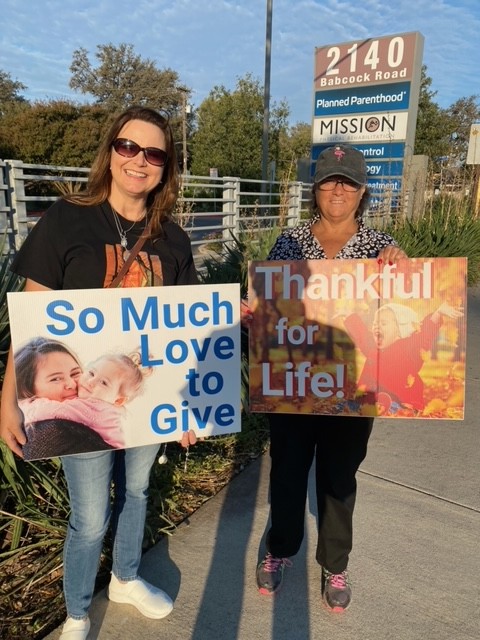
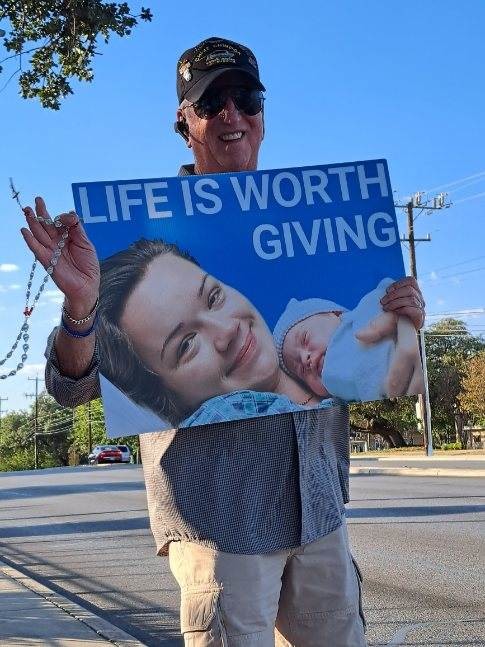
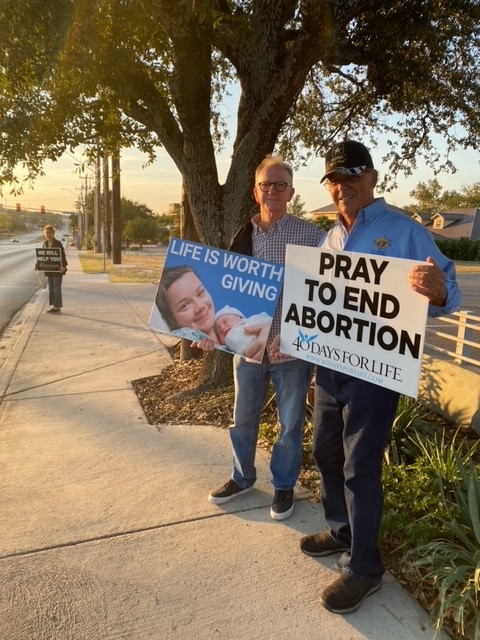
San Antonio Coalition for Life has come together for one goal; to end the injustice of abortion in our great city through peaceful prayer. Women, men and their children deserve better than abortion. Our hope is to show them the great love of God and to help them through this most difficult time. No one deserves to go through the agony of abortion.

The Latest from the Blog...

The fetus is just like tonsils or the appendix.

“The fetus is just a part of the pregnant woman’s body, like her tonsils or appendix.”


  1. A body part is defined by the common genetic code it shares with the rest of its body; the unborn’s genetic code differs from his mother’s.
  2. The child may die and the mother live, or the mother may die and the child live, proving they are two separate individuals.
  3. The unborn child takes an active role in his own development, controlling the course of the pregnancy and the time of birth.


A.) A body part is defined by the common genetic code it shares with the rest of its body; the unborn’s genetic code differs from his mother’s.


Every cell of the mother’s tonsils, appendix, heart, and lungs shares the same genetic code. The unborn child also has a genetic code, distinctly different from his mother’s. Every cell of his body is uniquely his, each different than every cell of his mother’s body. Often his blood-type is also different, and half the time even his gender is different.

Just as no two people have identical fingerprints, no two people have identical genetic fingerprints. If one body is inside another, but each has its own unique genetic code, then there is not one person, but two separate people.

A Chinese zygote implanted in a Swedish woman will always be Chinese, not Swedish, because his identity is based on his genetic code, not that of the body which he resides. If there were only one body involved in a pregnancy, then that body has two noses, four legs, two sets of fingerprints, two brains, two circulatory systems, and two skeletal systems. Half the time the child is male; clearly his sexual organs are not part of his mother’s body, but his own. In reality, it is a scientific fact that the mother is one distinctive and self-contained person, and the child is another.


B.) The child may die and the mother live, or the mother may die and the child live, proving they are two separate individuals.


The child-guest is a temporary resident of the mother-host. He will leave on his own as long as he is not prematurely evicted. There are many cases where a mother has been fatally inured, after which a doctor has delivered her child safely. The mother’s body dies, the baby lives. Unmistakably, the baby was not merely a part of his mother’s body, or he would have died with her. In California, a child was born several months after her mother was declared “brain dead.”1 Obviously they were two distinct individuals prior to the child’s birth.


C.) The unborn child takes an active role in his own development, controlling the course of the pregnancy and the time of birth.


New Zealand fetology professor A.W. Liley is known as the “father of fetology.” Among his many pioneer achievements was the first intrauterine blood transfusion. Dr. Liley has stated:

“Physiologically, we must accept that the conceptus is, in a very large measure, in charge of the pregnancy….Biologically, at no stage can we subscribe to the view that the fetus is a mere appendage of the mother….It is the embryo who stops his mother’s periods and makes her womb habitable by developing a placenta and a protective capsule of fluid for himself. He regulates his own amniotic fluid volume and although women speak of their waters breaking or their membranes rupturing, these structures belong to the fetus. And finally, it is the fetus, not the mother, who decides when labor should be initiated.”2


1. “Brain Dead Woman Gives Birth,” The Oregonian, 31 July 1987.

2. From a November 1970 speech titled “The Termination of Pregnancy or the Extermination of the Fetus.” Cited by Gean Garton, Who Broke the Baby? (Minneapolis: Bethany House Publishers, 1979), 41-42.


P.43 “Prolife Answers to Prochoice Arguments” By Randy Alcorn

“If the unborn is human, they have fewer rights than the woman.”

“Even if the unborn are human beings, they have fewer rights than the woman. No one should be expected to donate her body as a life support system for someone else.”


A.) Once we grant that the unborn are human beings, it should settle the question of their right to live.

B.) The right to live doesn’t increase with the age and size, otherwise toddlers and adolescents have less right to live than adults.

C.) The comparison between baby’s rights and mother’s rights is unequal. What is at stake in abortion is the mother’s lifestyle, as opposed to the baby’s life.


A.) Once we grant that the unborn are human beings, it should settle the question of their right to live.


One prochoice advocate, in the face of the overwhelming evidence, admitted to me that the unborn are human beings. He then added, “But that’s irrelevant to the issue of a woman’s right to have an abortion.”

But how can one’s humanity be irrelevant to the question of whether someone has the right to kill him? Wasn’t the black person’s humanity relevant to the issue of slavery, or the Jew’s humanity relevant to the ethics of the holocaust? Not only is the unborn’s humanity relevant, it is the single most relevant issue in the whole abortion debate.

Writing in the New York Times, Barbara Ehrenreich says, “A woman may think of her fetus as a person or as just cells depending on whether the pregnancy is wanted or not. This does not reflect moral confusion, but choice in action.”1

In this Alice-in-Wonderland approach, one’s choice is not made in light of scientific and moral realities. One’s choice is itself the only important reality, overshadowing all matters of fact. But if society operated this way, every killing of a person would be justifiable. The real issue would not be the worth of the person killed, but the free choice of the one doing the killing. If a man doesn’t want his wife, he can think of her as a nonperson. When he chooses to kill her this is not “moral confusion” but “choice in action.”

Ms. Ehrenreich goes on to say, “Moreover, a woman may think of the fetus as a person and still find it necessary and morally responsible to have an abortion.”2 We must not miss the implications of this viewpoint. It says that one may acknowledge the personhood of a fellow human being, yet feel that for one’s personal benefit it is legitimate—even “morally responsible”—to kill that other person. Though this is a logical conclusion of abortion-rights thinking, if carried out in our society it would mean the end of human rights and social justice.


B.) The right to live doesn’t increase with the age and size, otherwise toddlers and adolescents have less right to live than adults.


One author justifies some abortions based on his belief that “human worth and human rights grow with the physiological development.”3 If this is true, then human worth and rights continue to grow after birth, since we know physiological development continues after birth. Physical development continues year after year and takes on dramatic changes during adolescence. If human worth and rights grow with physiological development, then adults have a greater right to live than adolescents, who have a greater right to live than infants. It is morally preferable to kill an infant than a toddler, a toddler than a teenager, and a teenager than an adult.


C.) The comparison between baby’s rights and mother’s rights is unequal. What is at stake in abortion is the mother’s lifestyle, as opposed to the baby’s life.


Of course a child does not have more rights than her mother. Any two people are equal, and any two people have equal rights, Hence, a mother has every bit as much right to live is not an issue because her life is not in danger. (See previous blog)

The mother has not only the right to live, but also the right to the lifestyle of her choice—as long as that choice does not rob other people of even more fundamental rights, the most basic of which is the right to live. The right to a certain lifestyle is never absolute and unconditional. It is always governed by its effects on others.

Planned Parenthood states, “The desire to complete school or to continue working are common reasons women give for choosing to abort an unplanned pregnancy.”5 Completing school and working are desirable things in many cases, and pregnancy can make them difficult. But a woman normally can continue school and work during pregnancy. If she gives up a child for adoption she need not give up school or work. If she chooses to raise the child herself there are childcare options available if she must work outside the home. I am not suggesting this is ideal, nor do I say it callously, as I have worked with single mothers and know their difficulties. I am simply pointing out that there are alternatives, any one of which is preferable to an innocent child’s death. Regardless of the challenges, one person’s right to a preferred lifestyle is not greater than another person’s right to a life.


1. Cited by John Leo in “the Moral Complexity of Choice,” U.S News & World Report, 11 December 1989, 64.

2. Ibid.

3. William Tillman, Christian Ethics: A Primer (Nashville: Broadman Press, 1986), 114.

4. Peter Singer and Helen Kuhse, “On Letting Handicapped Infants Die,” in The Right Thing to Do: Basic Readings in Moral Philosophy, ed. James Rachels (New York: Random House, 1989), 146.

5. “Abortion: Facts at a Glance, ‘Planned Parenthood Federation of America, 1.


P.77 “Prolife Answers to Prochoice Arguments” By Randy Alcorn

"Soon that baby would die."

Dear SACFL,
       This last Thursday was my first time praying outside of Planned Parenthood. I have always considered myself "Pro-Life" but lately God had been calling me to act on convictions. So that's when I decided that being a prayer warrior was where I needed to start. That day I was full of hope and excitement, ready to do God's work. I was informed when I got there that on Thursdays they perform pre-abortion ultrasounds, an opportune chance to change someone's mind! I felt "charged" with energy thinking that I would get the chance to save a baby's life and put my beliefs into action! It felt great to be doing what God had called me to do. I figured it was a good warm-up before I came out to pray on Saturday morning. Abortion has always been a sensitive subject for me, I can hardly talk about it without tearing up. After Thursday however, I felt ready for whatever Saturday had in store.


        On Saturday Morning I woke up early and got my kids ready for the day. But as I brushed my teeth and washed my face I couldn't help but realize that somewhere at just this same moment, a woman was preparing herself to go to Planned Parenthood not to pray, but to have an abortion. It made me feel a little uneasy. "Can I really do this?", I asked myself. I suddenly felt unsure. I pushed through my doubts, loaded my son into the car and left my house. The forecast said it would be warm and sunny that day, but when we arrived at Planned Parenthood it was far from. It was dark and chilly, and I couldn't help but find it somehow fitting. It was a solemn day. I joined in a prayer vigil with others that were there and half way through a car pulled into the parking lot. A woman got out of the car and began to walk in, her head down the entire time. I was fixated on the sad look on her face and the helpless child she was carrying in her womb. Reality slapped me hard just then.


Soon that baby would die.


I couldn't hold it in, the tears started falling uncontrollably. I was praying as hard as I could, but couldn't seem to get a hold of my emotions. I felt helpless. I continued to pray knowing that's all that I could really do. I stayed the for two hours, watched several women come and go. I felt my heart break in my chest as I thought about what happened behind the clinic doors. I drove home in silence. It was the first time I have ever been so close to the horror of abortion, and it affected me so deeply. The rest of the day I tried to stay positive and hopeful. I was convinced that if I smiled long enough, that the pain of the morning would subside.
       After I laid my children down to sleep, I retreated to my room to get ready for bed. I could not contain it any longer, I put my head down and cried. My husband came in and asked what was wrong. I tried the "I'm fine" approach, but obviously I was not. I told him that I felt defeated because I was there to fight for those poor babies and I was unsuccessful. I prayed as hard as I could and those babies died anyway. My husband comforted me and told me that just because I didn't SEE anyone change their mind, doesn't mean our efforts were futile. He reminded me that we could have saved a life, or two, and never even know it. In my bedtime prayers I asked God for the strength to keep doing this, to continue in this journey. I realized that defeat is the wrong way to look at it. We can't always bear witness to the fruits of our labor. But most of all, we can never lose HOPE!! Hope will save the lives of unborn children.
        With that being said, I am so grateful to have the opportunity to be a prayer warrior. I want to keep coming back to the sidewalk on Saturdays. I feel more prepared for next week and the emotion it may bring. I imagine when I get home I will cry some more, but truthfully I don't mind. Someone needs to mourn for those babies and I am glad to do it. The next Saturday I am there though, I will remind myself that God is there with us and with Him, we are strong.
        Thank you for taking the time to listen to my story, I felt compelled to share my experience with you and I am so blessed to have had the opportunity to live it. Thank you for being so kind and helpful. I very much look forward to volunteering with SACFL from here on out.

God Bless!
Mallory L.
Syndicate content